

Barrambin Evidence Reaches Federal minister as Clearing Continues
Barrambin Evidence Presented to Federal Government Reps as destruction continues
14 August 2026
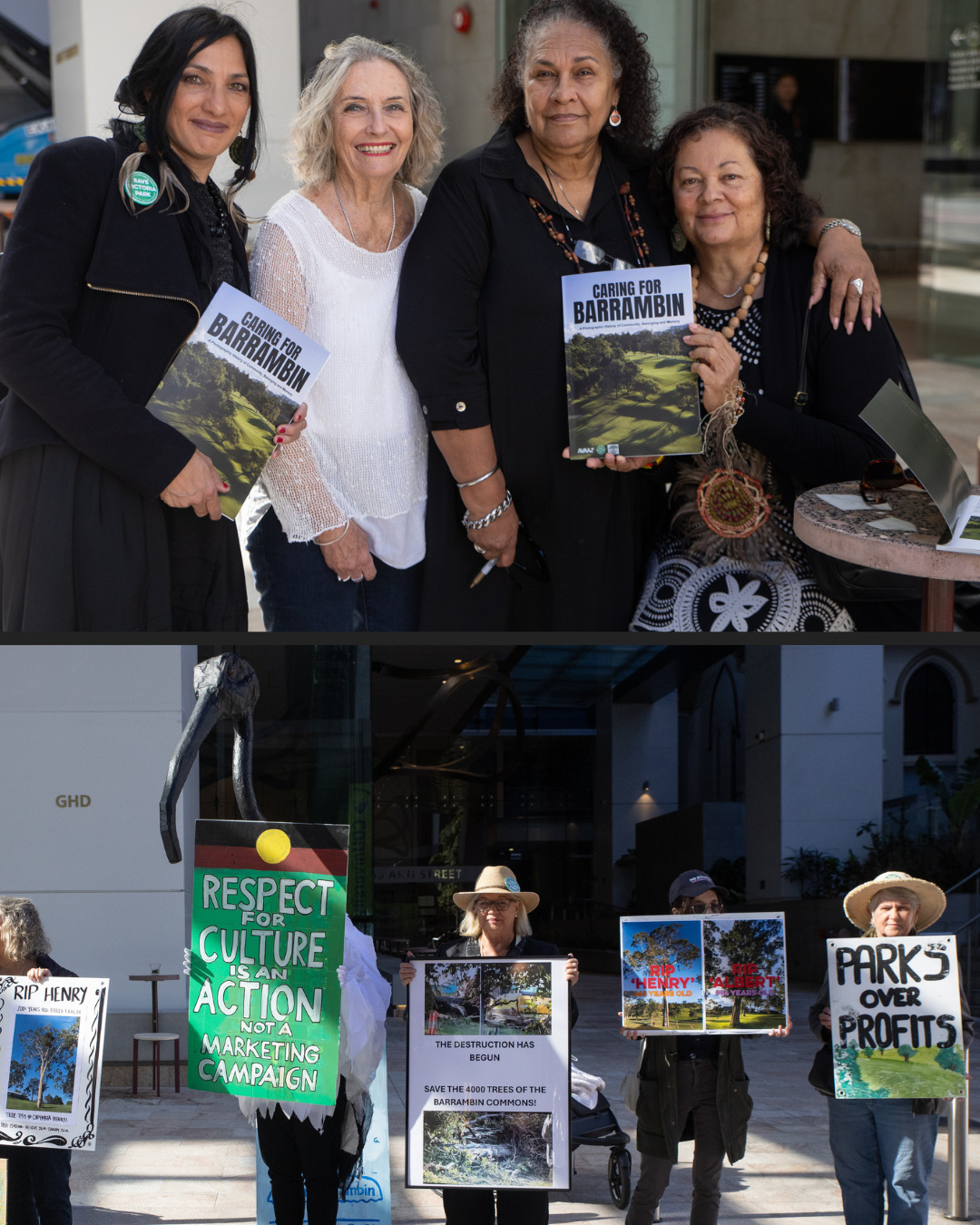
Yagara Magandjin Aboriginal Corporation (YMAC) strengthened its campaign to protect Barrambin/Victoria Park on 14 August 2026, announcing that Yagara Elders had presented a cultural heritage evidence book to Commonwealth representatives while clearing continued across the park.
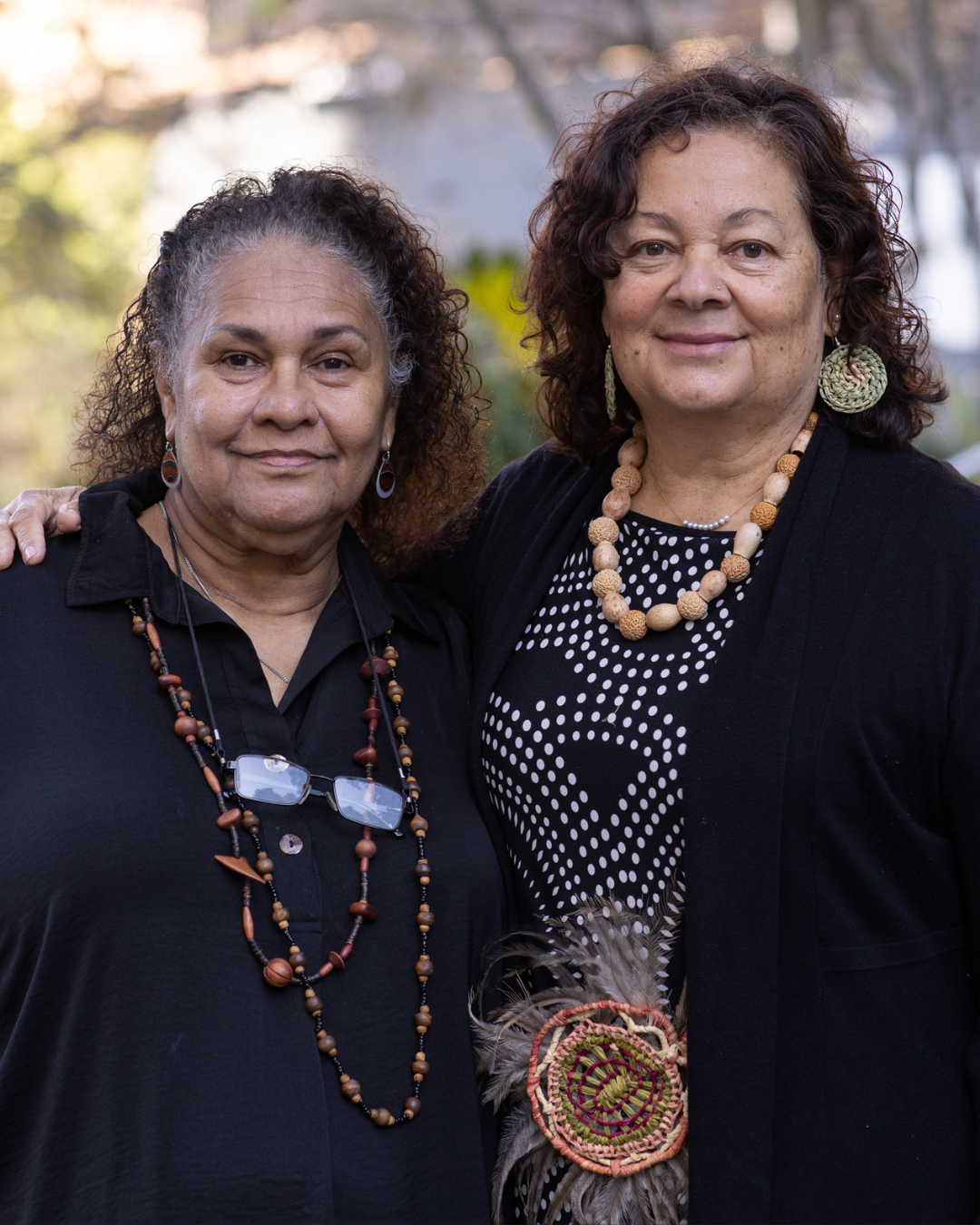
The photographs show YMAC Elders Aunty Sandra King OAM and Gaja Kerry Charlton with Save Victoria Park representatives and copies of Caring for Barrambin. YMAC said the book brings together evidence demonstrating the significance of Barrambin as a whole, including its old trees, sacred water systems and cultural heritage.
The handover occurred while federal protection processes remained unresolved. On 31 May 2026, Federal Environment Minister Murray Watt confirmed that four applications seeking longer-term declarations under section 10 of the Aboriginal and Torres Strait Islander Heritage Protection Act 1984 remained under assessment.
Brisbane City Council records that parts of the Herston side of Victoria Park/Barrambin were transferred to the Games Independent Infrastructure and Coordination Authority on 1 June 2026 for venue construction.
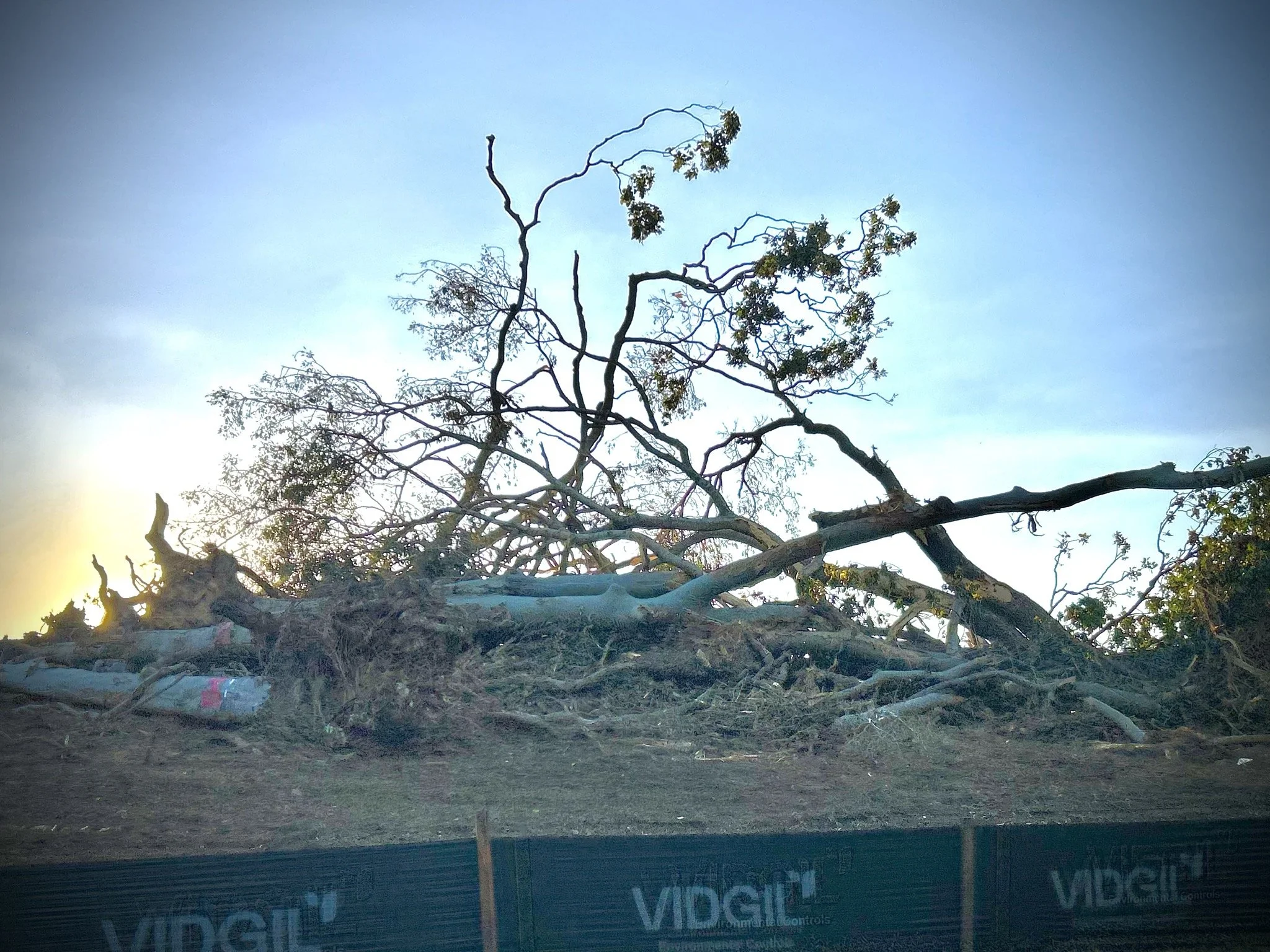
By 14 August, YMAC said it had documented the removal of at least 200 trees within a matter of days. YMAC also said Traditional Custodians had not been notified before the clearing. The figure of 200 trees remains a count reported by YMAC and should continue to be attributed accordingly unless an independently audited total becomes available.
Gaja Kerry Charlton said:
“This destruction could and should have been prevented while federal protection processes remained unresolved.”
“This book documents what is at risk, while the evidence from the ground shows the devastating impact on wildlife as trees and habitat are removed.”
Her message was direct:
“It is too late for what has already been lost, but there is still so much more to save.”
YMAC called for an immediate, mandatory pause on further irreversible works while the outstanding federal assessments were completed. It also called for Traditional Yagara Custodians to be directly involved in every decision affecting Country.
The handover placed months of cultural advocacy and collected evidence directly before those administering the federal process. It created a formal record that decision-makers had been asked to act before further irreversible loss occurred.
KEY FACT
Four section 10 applications remained under federal assessment on 31 May 2026. State works proceeding at the same time did not mean those applications had been decided
View the gallery
See the continuing photographic record of the destruction at Barrambin/Victoria Park: View the Barrambin gallery
Sources
Protection Was Sought Before the Trees Came Down
Updated 14 August 2026
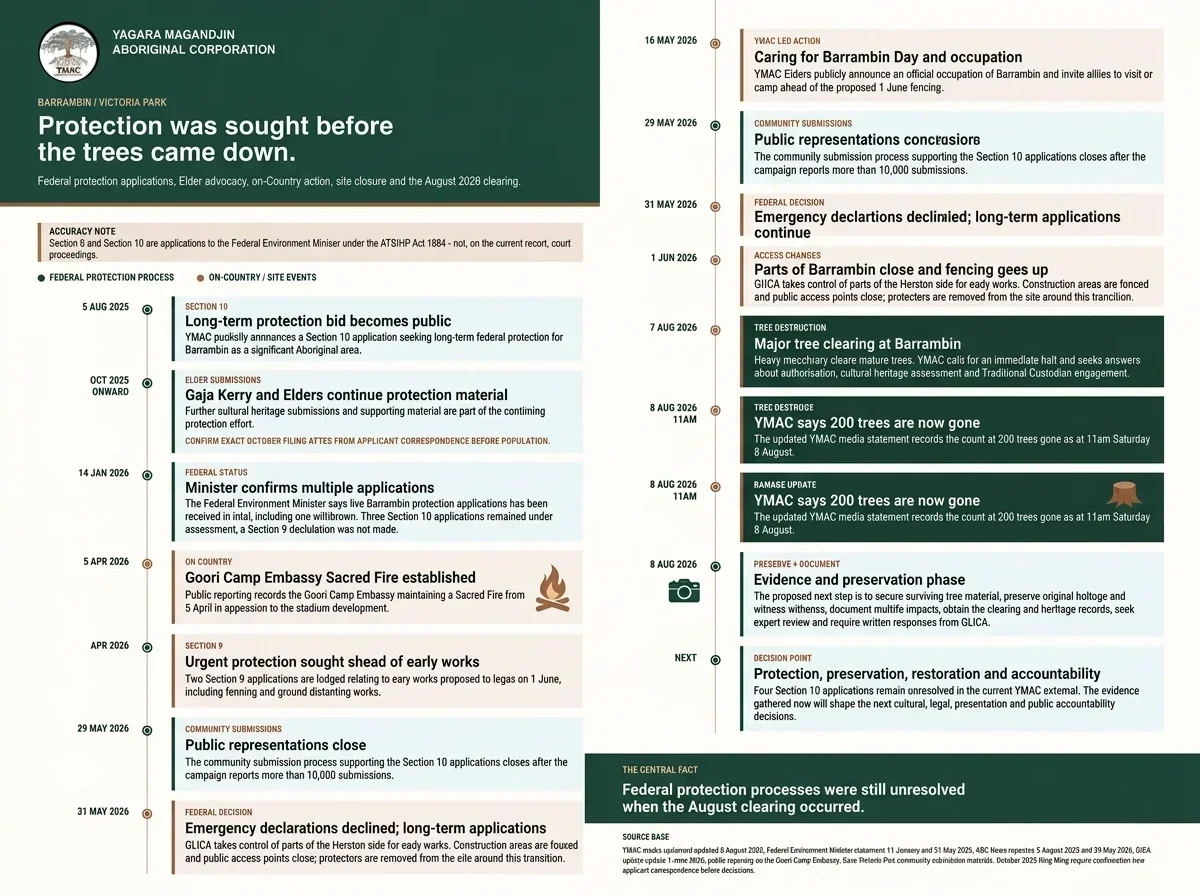
The documented timeline of the campaign to protect Barrambin/Victoria Park establishes one central fact: Yagara Elders sought protection long before the major tree clearing began in August 2026.
5 August 2025
Gaja Kerry Charlton and the Yagara Magandjin Aboriginal Corporation lodged an application seeking long-term protection for Barrambin under section 10 of the Aboriginal and Torres Strait Islander Heritage Protection Act 1984.
Gaja Kerry said:
For us Yagara custodians, Barrambin is living Country, possessing sacred, ancient and significant relationships within our cultural heritage systems. Our wildlife is part of those relationships. The cockatoos and kookaburras belong to this Country too. Their environment has been pummelled—their trees, shelter and familiar habitat torn away around them. They have been displaced, left distressed and searching for safety. They are suffering. It is cruel, and it should never have been allowed to happen
“We stand resolute in our responsibility to protect it.”
17 September 2025
Aunty Sandra King OAM lodged a further section 10 application seeking federal protection for Barrambin.
Aunty Sandra said:
“Our stories, our traditions are in the ground here—in the vegetation, the trees, the lakes, the hills.”
“Barrambin is one of the last locations of untouched beauty and cultural heritage in this city—and we hold on to that. It is irreplaceable.”
14 January 2026
Federal Environment Minister Murray Watt declined an urgent section 9 application but acknowledged Barrambin’s cultural significance. He confirmed that three section 10 applications remained under assessment
31 May 2026
The Minister said ten applications had been received in total, including two that had been withdrawn. He declined two section 9 applications relating to proposed fencing and ground-disturbing early works.
However, another section 9 application and four section 10 applications remained under assessment. A section 10 reporter had also been appointed to undertake a more detailed review.
1 June 2026
Brisbane City Council records that parts of the Herston side of Victoria Park/Barrambin were transferred to the Games Independent Infrastructure and Coordination Authority for delivery of the proposed stadium and National Aquatic Centre.
6–8 August 2026
Save Victoria Park reported extensive tree clearing on 6 and 7 August. By 8 August, YMAC said it had documented the removal of at least 200 trees.
That figure remains a count reported by YMAC and should be attributed accordingly unless an independently audited clearing total becomes available.
14 August 2026
Yagara Elders presented the cultural heritage evidence book Caring for Barrambin to Commonwealth representatives involved in the federal heritage process.
Following the handover, Gaja Kerry said:
“This destruction could and should have been prevented while federal protection processes remained unresolved.”
“It is too late for what has already been lost, but there is still so much more to save.”
YMAC called for an immediate, mandatory pause on further irreversible works and for Traditional Yagara Custodians to be directly involved in decisions affecting Country.
KEY FACT
Applications, representations and cultural advocacy were active many months before the machinery arrived. Four section 10 applications remained under federal assessment when major tree clearing began.
View the photographic record
Follow YMAC’s continuing record of the destruction at Barrambin/Victoria Park: View the Barrambin gallery for more
Sources
It All Begins Here
Our vision & purpose
August 7, 2026
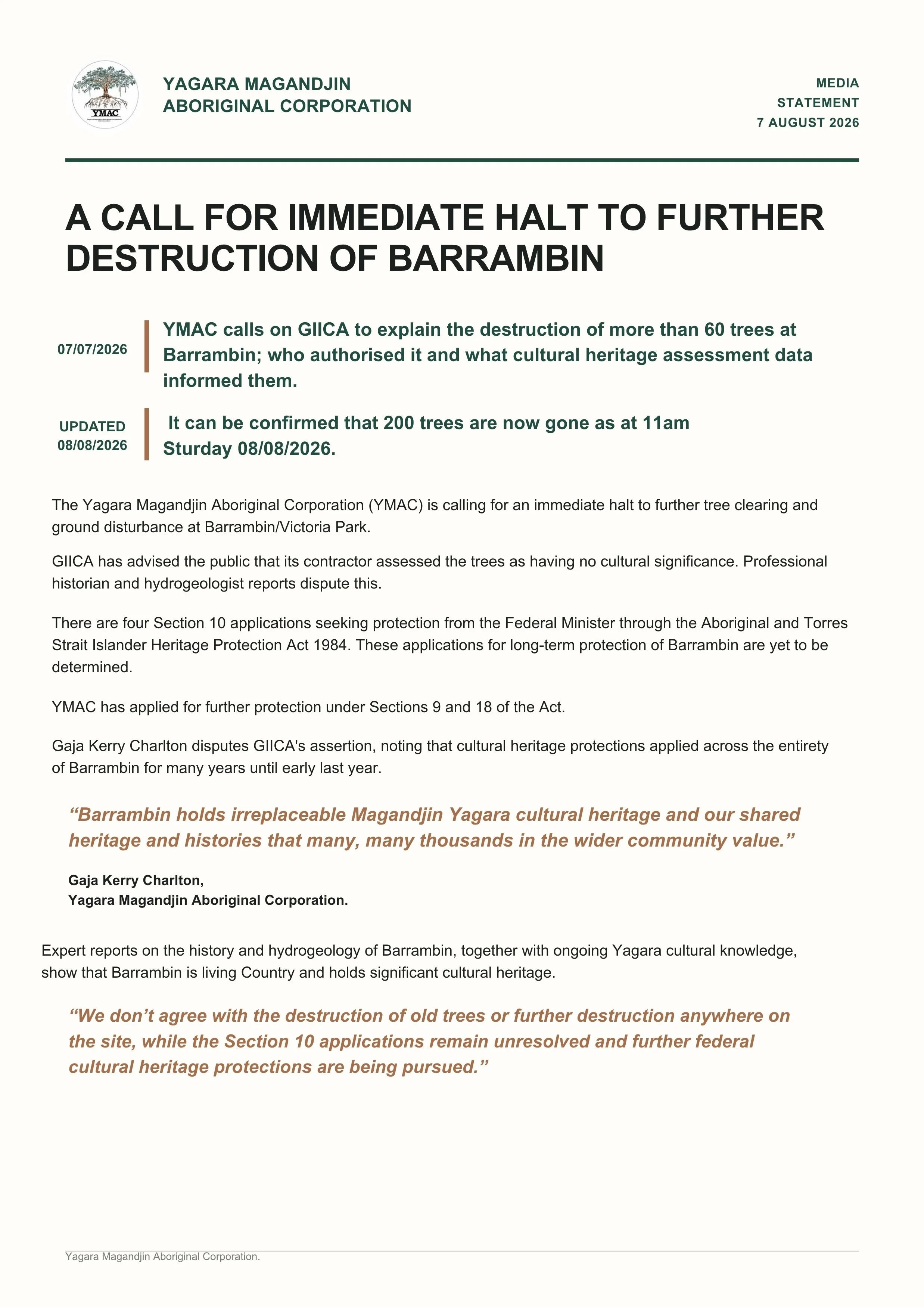
Yamara Magandjin Aboriginal Corporation (YMAC) today issued a media release announcing [concise subject — replace with actual subject]. The release outlines the organisation’s position, key facts and next steps relevant to First Nations communities, stakeholders and the broader public.
we are not going anywhere
threatened wildlife need saving now
When mature trees began falling at Barrambin/Victoria Park on 6 August, community observers reported seeing possums, cockatoos and other birdlife fleeing the clearing area.
Those accounts were reported by InDaily Queensland. The same report included GIICA’s response: the authority said fauna spotter-catchers and heritage personnel were present, and that ecologists would follow protocols to relocate fauna or eggs found during clearing.
Both parts of that report matter.
It would be wrong to state as fact that no wildlife specialists were present. It would be equally wrong to dismiss what residents and campaigners witnessed simply because individual animals may have been moved.
A wildlife spotter can relocate an animal. They cannot relocate an ecosystem.
They cannot recreate an old tree hollow, restore a lost canopy overnight or immediately replace the seasonal supply of nectar, fruit, insects, shade and protection provided by a mature tree. They cannot guarantee that a displaced possum, bird or bat will find an unoccupied refuge nearby.
Earlier ecological work prepared for Brisbane City Council identified 41 hollow-bearing trees at Victoria Park and 34 particularly old trees with trunks exceeding 1,200 millimetres in diameter. The records are preserved with the former Council planning documents on the Save Victoria Park resources page.
These are not cosmetic features.
Research published through CSIRO has found that many Australian birds, bats and arboreal mammals depend on hollows, with den trees used by many mammals being at least 100 years old. Australia has as many as 300 native vertebrate species that use tree hollows. CSIRO research explains the importance of these structures, while the NSW environment department warns that hollows may take hundreds of years to form and are not easily replaced.
Planting a sapling later is not an ecological substitute for retaining a mature habitat tree now.
The project’s own federal environmental referral identified the vulnerable grey-headed flying-fox, endangered koala, vulnerable white-throated needletail and migratory fork-tailed swift as species that were known, considered likely or assessed because of their regional significance. The referral acknowledged that trees used as feeding resources by grey-headed flying-foxes would be removed, although it argued that the animals were mobile and had alternative habitat elsewhere in Brisbane. Read the official EPBC referral.
On 5 May 2026, the Commonwealth determined that the project was “not a controlled action” under the federal environment law. That decision means the project was considered unlikely to have a significant impact on nationally protected environmental matters. It does not mean that no trees, habitat or local wildlife will be affected. The decision notice is available here.
That distinction is essential.
A possum does not need to be nationally threatened before the destruction of its den matters. A cockatoo does not need to fall from a tree before the loss of its nesting hollow becomes real. A park does not need to be pristine wilderness before it has ecological value.
Barrambin is an inner-city refuge. More than 60 bird species have been recorded in and around the park, alongside possums, microbats, reptiles, frogs, insects and pollinators. Save Victoria Park has compiled an overview of its wildlife, including a link to the York’s Hollow eBird records.
Before further clearing occurs, the public deserves access to clear, tree-by-tree information: which trees will be removed, which contain hollows, what pre-clearing inspections occurred, what animals were found, where they were relocated and how their survival will be monitored.
If strong protection protocols are genuinely operating, publishing that information should not be controversial.
Wildlife should not be reduced to a carcass count after the bulldozers have passed. The real measure is whether habitat remains capable of sustaining life.
Barrambin is not empty land awaiting a better use. It is already alive.
Learn more and support the campaign at Save Victoria Park.